
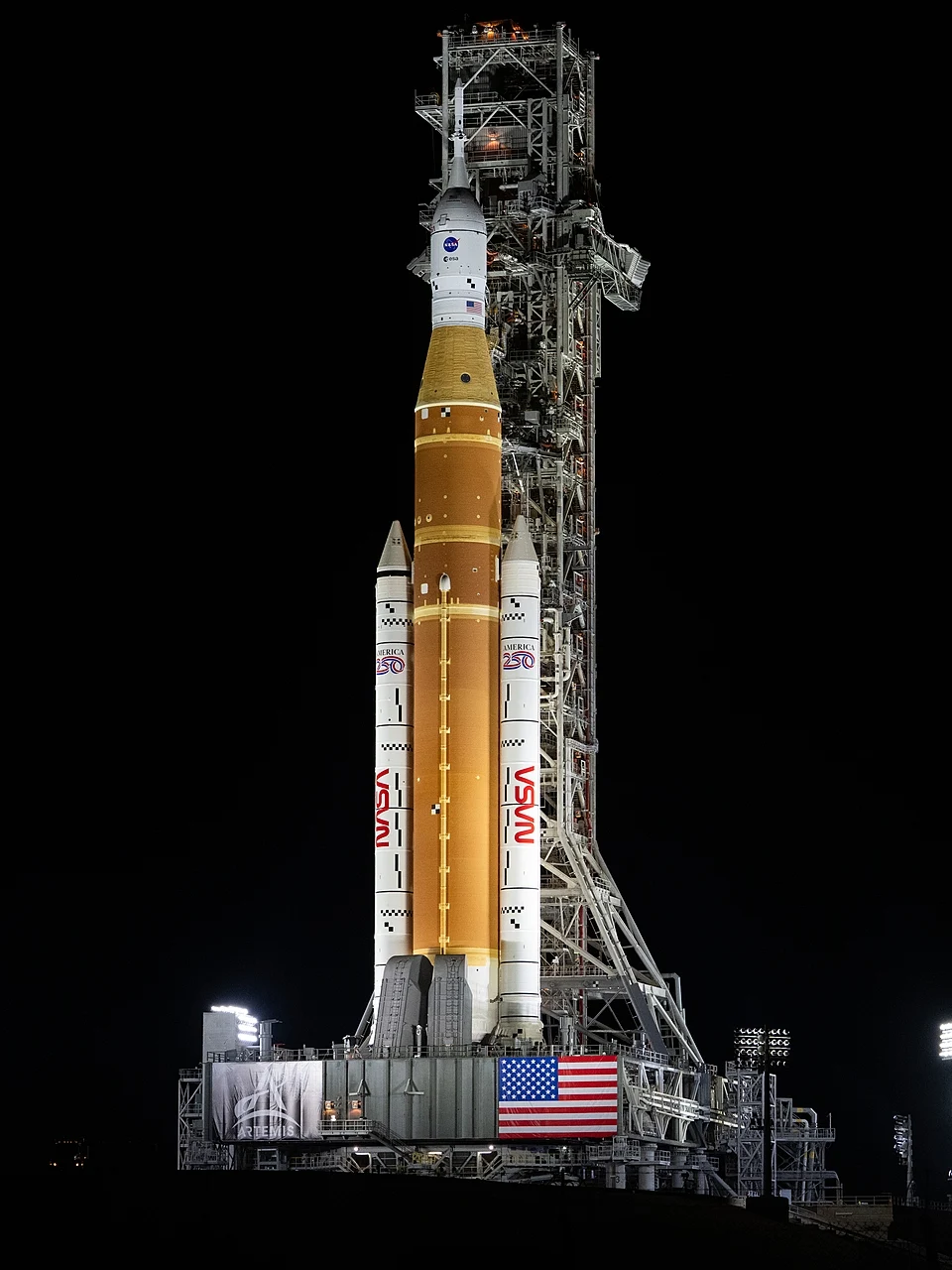


Well. This is a timeframe that I thought was going to be a bit earlier, I can’t lie. That said, I’m pleased that despite the delays post-Artemis I, we are indeed sitting here, as of time of publication, under a week away from the opening of the first window for Artemis II. EDIT (FEB 19): As of now, Artemis II is currently slated for launch NET MARCH 6th.
All that said, there’s a lot to cover ahead of the first manned Artemis mission and humanity’s first manned lunar expedition in nearly 50 years.
Buckle in, folks. We’re in for a good one. This is gonna be a MONSTER article with four major segments:
- The Rocket: The Space Launch System
- The Capsule: The Orion vehicle, Integrity.
- The Mission Profile of Artemis II
- The Crew of Artemis II
The Space Launch System Rocket
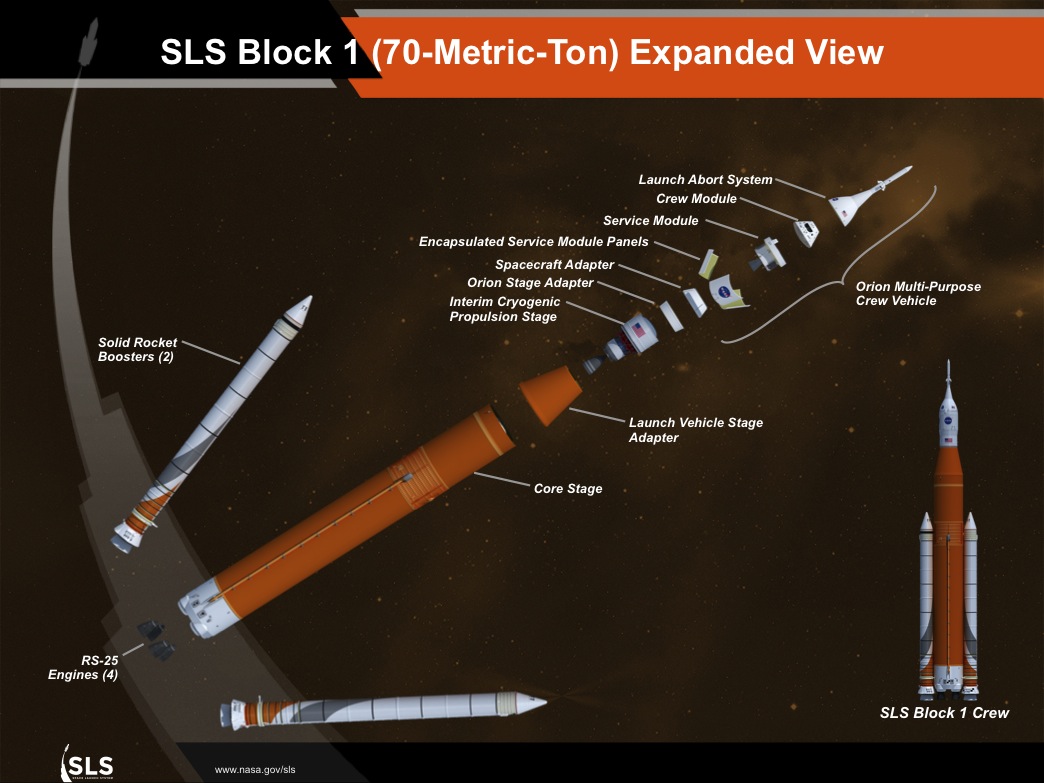
Alright, alright, let’s get the big orange beast out of the way first. The rocket for this mission is the SLS — the Space Launch System. While technically what’s known as an “SDLV” – a Shuttle-Derived Launch Vehicle, meaning it shares some commonality with the Space Shuttle, SLS is such a dramatically different beast that it’s been years behind schedule. (Thanks, Boeing.)
However, that’s not to say that this vehicle is without its pedigree. Each of the 4 RS-25D engines powering the Core Stage — the giant orange tank that gives SLS its signature look — are indeed flight-proven hardware. As a matter of fact, E2047 will be making its 15th flight, having first journeyed to space on STS-91, all the way back in 1998, almost 30 years ago.

SLS Heritage and Upgrades
WARNING: TECHNOBABBLE AHEAD!
What’s a “Block 1” SLS and What Does That Mean?
This is the second of a planned three SLS Block 1 launches. Block 1 is differentiated from the upcoming Block 1B by the upper stage: Block 1 uses the ICPS, the Interim Cryogenic Propulsion Stage, powered by 1 RL-10 liquid hydrogen engine – the same engine that powers the Centaur upper stage for Atlas and Vulcan – while the upcoming Block 1B, scheduled to debut on Artemis IV, uses the EUS: the Exploration Upper Stage, powered by 4 RL-10 engines.
Even further into the future is the planned Block 2 upgrade, which will overhaul the Solid Rocket Boosters attached to each side of the Core Stage that give it the Shuttle-esque look that it remains reminiscent of.
Each of these other aspects of the SLS also have some curious heritage, as well.

The Interim Cryogenic Propulsion Stage — ICPS
The ICPS is derived from the DCSS – the Delta Cryogenic Second Stage. Specifically, it’s a heavily modified version of the 5-meter diameter version that supported most Delta IV launches (including every Delta IV Heavy). This includes its tanking and tank design, but not the engine specifications! Unlike every previously designed and flown stage, including the one that flew on Artemis I, the engine onboard the ICPS for Artemis II is an RL-10C-2, rather than the long-lived RL-10B-2. While we don’t have exact numbers published, the C-2 is known to be an intermediate version between the B-2 and the C-3, the variant planned for the EUS, in weight, thrust, and manufacturing techniques.
Whew. Okay, that’s a lot of technospeak, even by my standards.
In case you didn’t read all that… (I don’t blame you!)
- The ICPS comes from the Delta rocket family’s upper stage!
- The engine used on this mission and the next is an intermediate between past versions used on Delta and the upcoming Exploration Upper Stage.

SLS Solid Rocket Boosters
Okay, we’re gonna get into a little bit more technospeak, but I’m gonna do my best to keep it to a minimum. May the great editor in the sky strike me down if I fail. Here we go.
The SRBs (Solid Rocket Boosters) for SLS Blocks I & IB are what’s known as (brace yourselves) five-segment Shuttle-derived Solid Rocket Boosters.
What on earth does that all mean? Well, taking it one section at a time:
Five-segment: This one is the most curious of the terms, so we’ll come back to this one.
Shuttle-derived: This means that the boosters for this time frame use the same exact hardware as were used during the Space Shuttle program. And I do mean the same exact hardware. During the Shuttle program, the boosters had parachutes in the nose cone sections that enabled them to be recovered, taken apart, refurbished, refueled, and reflown. This means that the boosters for Artemis I-VIII are all going to be using a mix-mash of past Space Shuttle hardware, doomed for one final flight to a watery grave in the Atlantic.
Solid Rocket Boosters: Well, this is one that is much better explained by people far more experienced than this humble writer. Instead, I’m going to pull a short brief video that shows the basics.
Still confused? That’s okay. Solids are weird. Here’s some basic points:
- Once started, they burn to completion.
- They have to be started with an external (or internal!) ignition. They’re actually pretty stable on the ground without an ignition, at least in terms of rocket propellants.
- They’re also very old! The simplest form is quite simply gunpowder in a tube. The earliest rockets that we know of are from China, where they were potentially used as far back as the thirteenth century during the Song Dynasty.
Five-Segment: Alright, let’s try this again. The sub-term “segment” here is referring to the segments of fuel within the solid-rocket motor. For safety reasons, they’re manufactured such that the fuel casings are separated with intermediary buffers between them. For the Space Shuttle, these were “four-segment” motors, meaning that inside of each solid booster, there were four separate fuel segments. For SLS, there are five such segments, again, separated.
Each of these SRBs provides a MONSTROUS amount of thrust, by the way — on the order of 3.3 MILLION pounds of thrust at liftoff, over double the F-1 engine’s 1.5 million, which was used to power the Saturn V.
Whew. I think that’s everything relating to the SLS. I sure hope I haven’t missed anything major.
What do you mean I skipped the Core Stage-
Fine, I’ll talk about the big orange Core Stage.
The Core Stage is, as the name might suggest, the core of the SLS vehicle. Sometimes known as “the big orange rocket” due to the Core Stage’s distinct coloration, it’s actually the same width as the Space Shuttle’s External Tank (ET). Additionally, it also uses the same diameter tanks as well as the same fuels used in the ET, though it’s significantly taller than the ET. Further, the Core Stage is the only part of the SLS to have no direct heritage back to the Shuttle era; while similar manufacturing techniques are used on the Core Stage as were used on the ET, it bears very little technical similarity otherwise.

As for the peculiar orange color, that actually comes not from the material of the tanks or from paint, but instead from the insulating foam, the same reason the ETs for the Shuttle Program were orange. As a matter of fact, the Core Stage holds some 730,000 gallons of fuel when fully loaded, like it will be ahead of today’s Wet Dress Rehearsal1.
Orion Integrity
This will mark the second (or third, depending on who you ask) spaceflight of the Orion capsule, the first having come over three years ago on the mission of Artemis I, but it does mark the first crewed mission aboard Orion. For this mission, the crew of Artemis II (more about them later!) have named their capsule Integrity, saying it “embodies the foundation of trust, respect, candor, and humility across the crew and the many engineers, technicians, scientists, planners, and dreamers required for mission success.”2
Orion is a capsule that’s been in the works for a very long time. Originally designed as the Crew Exploration Vehicle under the Constellation program, it would be revived a year after that program’s cancellation, in 2011, as the Orion MPCV — Multi-Purpose Crew Vehicle — with its initial plans being for use on missions like the ARM (Asteroid Redirect Mission) as well as potentially for launch into LEO. However, it was quickly realized that NASA’s commercial partners could work in LEO and to the ISS far cheaper than NASA could themselves, which led to the MPCV aspect being dropped.
Now, why the debate over how many times Orion has flown?
EFT-1

Orion first technically flew in 2014, aboard a Delta IV Heavy, on a launch known as Exploration Flight Test – 1, shortened to EFT-1. It was a four-hour, two-orbit test mission designed to shake out Orion’s heat shield technology and onboard systems. However, very little of the Orion capsule itself was actually finished aside from those systems, as it contained no crew facilities or life support, among numerous other exclusions, leading some to dub this Orion as the “Orion Lite“.

Artemis I
Now, this one’s a good bit more straight-forward.
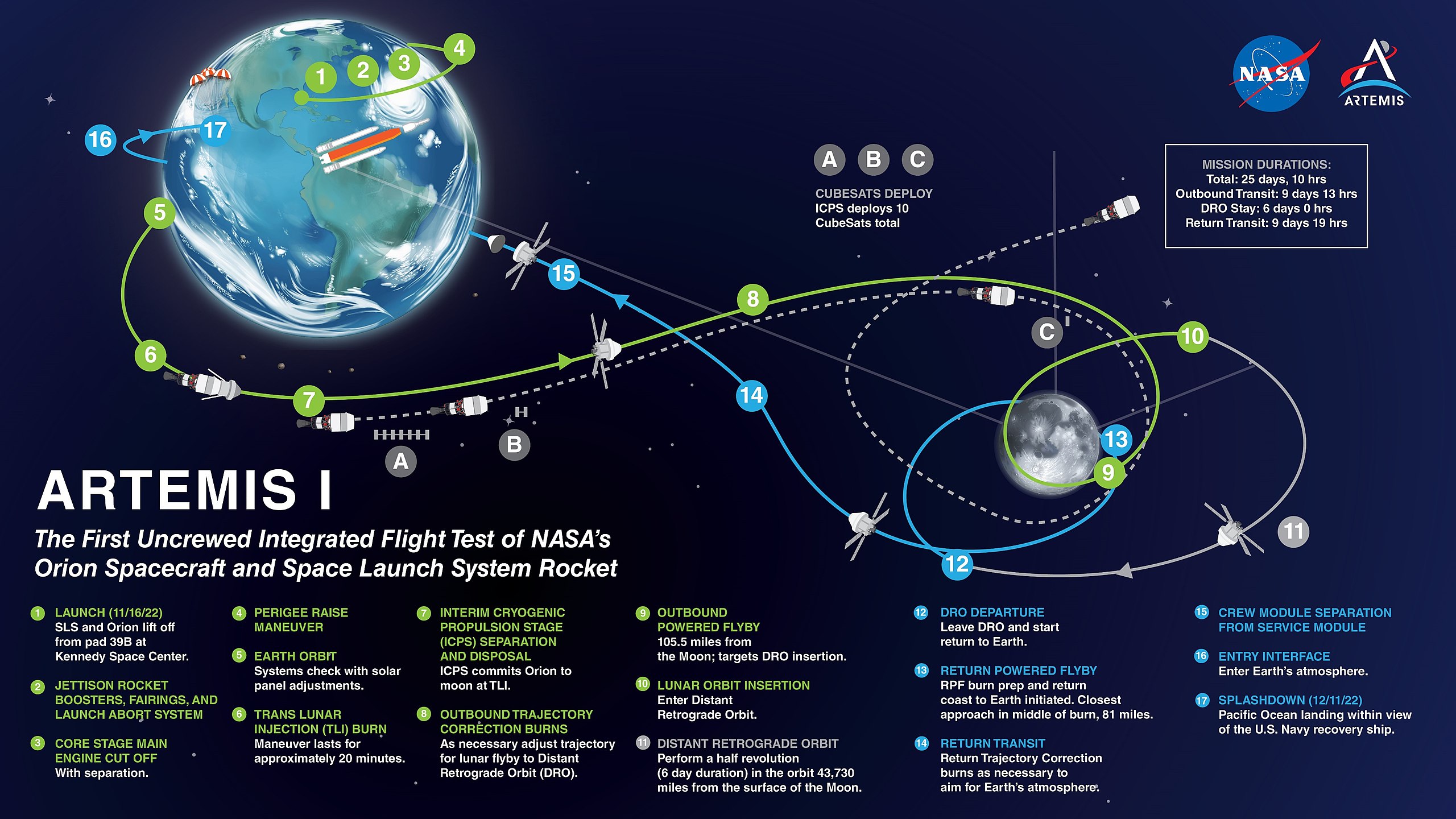
Artemis I launched a little over three years ago, in December of 2022. Like EFT-1, this was another uncrewed test flight, but unlike that mission, was flown with a fully capable Orion spacecraft launched aboard the first SLS. This was a 25-day mission that sent Orion far beyond the moon, into a distant, looping orbit, before eventually bringing it home, running the entire spacecraft — including its long-lived AJ-10 engine3 — through its paces.
In fact, the image from earlier in this article is actually from Artemis I, with that gorgeous shot of liftoff. If Artemis II launches this window, then expect similar views this go-around!
Orion itself performed flawlessly on this un-crewed “dress rehearsal”, but there were concerns about the performance of the heat shield. In fact, that’s one factor as to what originally delayed Artemis II out of 2024 into this year. However, NASA is taking a gentler re-entry profile on this mission to mitigate the concern further and, starting on Artemis III, will be using a slightly different compound in the heat shield to help with heat management.
Artemis II: The Mission Plan
Alright, now for what you’re likely all here for: the mission of Artemis II itself.
The mission is currently slated to launch on the evening of February 8, 2026, just after Super Bowl LX between the Seahawks and Patriots in Santa Clara, CA. This will be the first crewed mission to the moon since Apollo 17 in 1972, and while not landing crew on the lunar surface, is still a remarkable plan for a first crewed flight.
This is going to be a roughly 10-day mission, with a day spent in orbit around the Earth before a slingshot maneuver to send the spacecraft and crew all the way around the Moon on a free-return trajectory — the same trajectory as on the famous Apollo 13 — before returning home.
The mission is stripped into a couple of different phases, so I’ll do my best to break them down.
Launch
The crew will be launching from Launch Complex 39B. Engines will ignite at 7 seconds before liftoff, and if no issues are detected before T-0, the hold-down bolts will blow and the SRBs will ignite. The boosters will burn for about 2 minutes before they’re jettisoned, some 30 miles up and at a speed of 3100 mph. The core stage will burn for another eight minutes before shutting down and separating from the ICPS stack, followed thereafter by a hectic checkout period. The core stage won’t be putting the entire stack into orbit, rather into an elliptical semi-orbit. Should there be any glaring problems, they can end the mission right then and there and ride home in Orion to safety.
Hopefully, of course, there are no problems, and the mission can proceed. In this case, the ICPS will ignite its RL-10C engine for a short burn at apogee — a point some five times higher than that of the ISS’ orbit for this mission — and place itself into a low earth orbit. Again, the spacecraft will undergo a battery of tests to ensure it’s cleared to proceed. Should everything remain good, the ICPS will ignite a second time to send Orion into a high earth orbit, one with a period of ~23.5 hours, for a full shakedown orbit. This is a long burn, taking about 15 minutes. At this point, Mission Specialists will take over control of Orion for a series of rendezvous proximity operations, performing station-keeping tasks with the ICPS similar to what was performed during the Gemini program. Once this is complete, the crew will finally end the launch period to convert the cabin into its flight configuration and have a good (we hope!) meal.
Lunar Operations
After completing the full high-Earth orbit, Orion will perform its own TLI (Trans-Lunar Injection) maneuver using its service module engine to enter the free-return trajectory. The outbound journey will take approximately four days, while the crew will be monitoring everything with the spacecraft’s systems, along with gathering data on the effects of deep-space flight on humans, as well as performing trajectory corrections as needed.
Orion will fly around the Moon at a closest approach of just over 4000 miles above the lunar far side, the first every far-side approach with the far side in the light. This is likely going to be the first time human eyes have ever seen some parts of the far side of the moon, as the Apollo program’s astronauts only saw the near side under landing lighting conditions.
Following the fly-by, the crew will again be monitoring spacecraft systems and performing observations over the full four-day return journey, as well as likely performing corrective burns along the way home to ensure an accurate return.
Re-entry and Splashdown
Integrity will enter Earth’s atmosphere at the end of a nominal mission at a speed of approximately 25,000 miles an hour, the fastest re-entry ever attempted. They will be attempting to perform a “skip re-entry”, briefly dipping into the atmosphere to use it to bounce back up briefly, burning energy and dissipating heat, as well as enabling a more precise landing. Splashdown is planned to occur in the Pacific off San Diego, CA, where the crew and spacecraft will be recovered using a San Antonio-class amphibious transport dock.
Other Missions
While Artemis II’s main mission is to send people around the moon for the first time since the 1970s, there are some smaller lesser known CubeSats that will be hitching a ride with them.
First up is Neurospace’s TACHELES; the satellite will test the electronics for the HiveR rover through the Van Allen radiation belts.
Argentina’s Comisión Nacional de Actividades Espaciales (CONAE) will be flying their CubeSat that will be collecting radiation data to measure the spectrum around earth and collect GPS data for future mission.
The Korea AeroSpace Administration (KASA) will be flying a CubeSat with a material designed to mimic human tissue to gather data on the biological affects of the Van Allen belts.
The Saudi Space Agency will be flying a CubeSat designed to measure space weather at various distances from earth.
There are also a few other CubeSat payloads along for the ride as well, so if you’re curious, give them a look up!
The Crew of Artemis II
Commander Reid Wiseman, NASA

Reid Wiseman was selected to become an astronaut as part of NASA’s Astronaut Class 20, selected in 2009, and finished qualification in 2011. Wiseman was a part of ISS Expedition 40/41 in May – November 2014, launching and returning aboard Soyuz TMA-13M.
After his stint on-station, Wiseman sat on reserve for several years before eventually being selected to be Chief of the Astronaut Office, where he would serve from 2020 until 2022. He would resign that role to return to active rotation, being selected for Artemis II a few months after that in April 2023. This will be his second spaceflight.
Prior to his time at NASA, Wiseman served in the Navy, being deployed as a part of Operations Enduring & Iraqi Freedom, and also worked on the development team for the F-35C Lightning II.
Pilot Victor Glover

Victor Glover was selected to be an astronaut as a part of NASA’s Astronaut Group 21, announced in 2013, and qualified in 2015. His first spaceflight was on SpaceX Crew-1 as a part of Expedition 64/65, launching in November 2020 and returning in May 2021. While on station, Glover was selected for future Artemis training. This will be his second spaceflight.
Prior to his time at NASA, Glover was also in the Navy, also serving in Operation Iraqi Freedom, and was a test pilot in VX-31 based out of NAWS China Lake in California. Additionally, he also served a tour deployed on the USS George Washington in the Western Pacific, and accrued 3000 flight hours in more than 40 aircraft, completed 400 carrier landings, and operated on 24 combat missions.
Mission Specialist Christina Koch

Christina Koch was selected as a part of NASA’s Astronaut Group 21, like Glover, and followed the same timeline. She was a part of ISS Expeditions 59/60/61, serving the longest single-spaceflight mission by a woman ever at 328 days, as well as the longest first spaceflight of any NASA astronaut. This will be her second spaceflight.
Prior to becoming an astronaut, Koch was a member of NOAA, serving in various far-off locales as a researcher. She worked as a research associate in the US Antarctic Program between 2004-07, including an over-winter at Amundsen-Scott South Pole Station, while spending an additional winter at Palmer Station.
She also worked as an engineer in the Space Department at the Applied Physics Laboratory at Johns Hopkins focusing on space science instrument development, including radiation instruments for the Juno and Van Allen Probes programs. She also served as Station Chief at NOAA’s American Samoa Observatory.
Mission Specialist Jeremy Hansen, CSA

Jeremy Hansen is the only non-American on the mission of Artemis II. He was originally selected as a part of the 2009 CSA selection, and was trained as a part of NASA Astronaut Group 20 alongside Wiseman. He is also the only member of the prime crew to not have any previous flight experience, making him the first Artemis astronaut to debut as part of the program.
Prior to his selection as an astronaut, Hansen served in the RCAF and was a pilot of the CF-18 at CFB Cold Lake, Alberta. Additionally, he was also the Canadian flagbearer at the coronation of King Charles III, after having been named to the crew of Artemis II. Should the mission proceed as planned, Hansen will be the first non-American to travel beyond LEO.
Whew. That’s… a long article. We here at Max-Q will continue to keep a weather eye on the horizon for any future updates and place them down here at the end of this article. As of the time of publication, the WDR is currently ongoing, with an official targeted launch set for NET February 8th.
UPDATE: As of the time of this update, NASA is currently preparing to run a second Wet Dress Rehearsal and fueling test after finding more liquid hydrogen leaks within the mast structure during testing on Feb. 2nd. Additionally, as of Feb. 19th, 2026, launch is currently slated for NET March 6th.

Hey, y’all! I’m Ethan, I go by Beagle, and I write space. I am a part of the Max-Q News team, as well as one of two hosts for the Max-Q Podcast!
- For more info about the Wet Dress Rehearsal, which is a far more complex program than I can easily explain here, check out this article from NASA. As of the time of writing, preparations for this are currently ongoing, and the fueling is scheduled to take place on the evening of Monday, February 2. ↩︎
- That quote comes directly from the crew and can be found here. ↩︎
- At some point, we need to do an entire article about the history of the AJ-10, because it quite literally dates all the way back to the dawn of the space age and the Vanguard program, with this specific model first flying in 1981 on STS-1, the very first Shuttle mission. This is an engine with almost 70 years of family heritage and 45 years of direct experience. Absolutely bonkers. ↩︎


Leave a Reply