
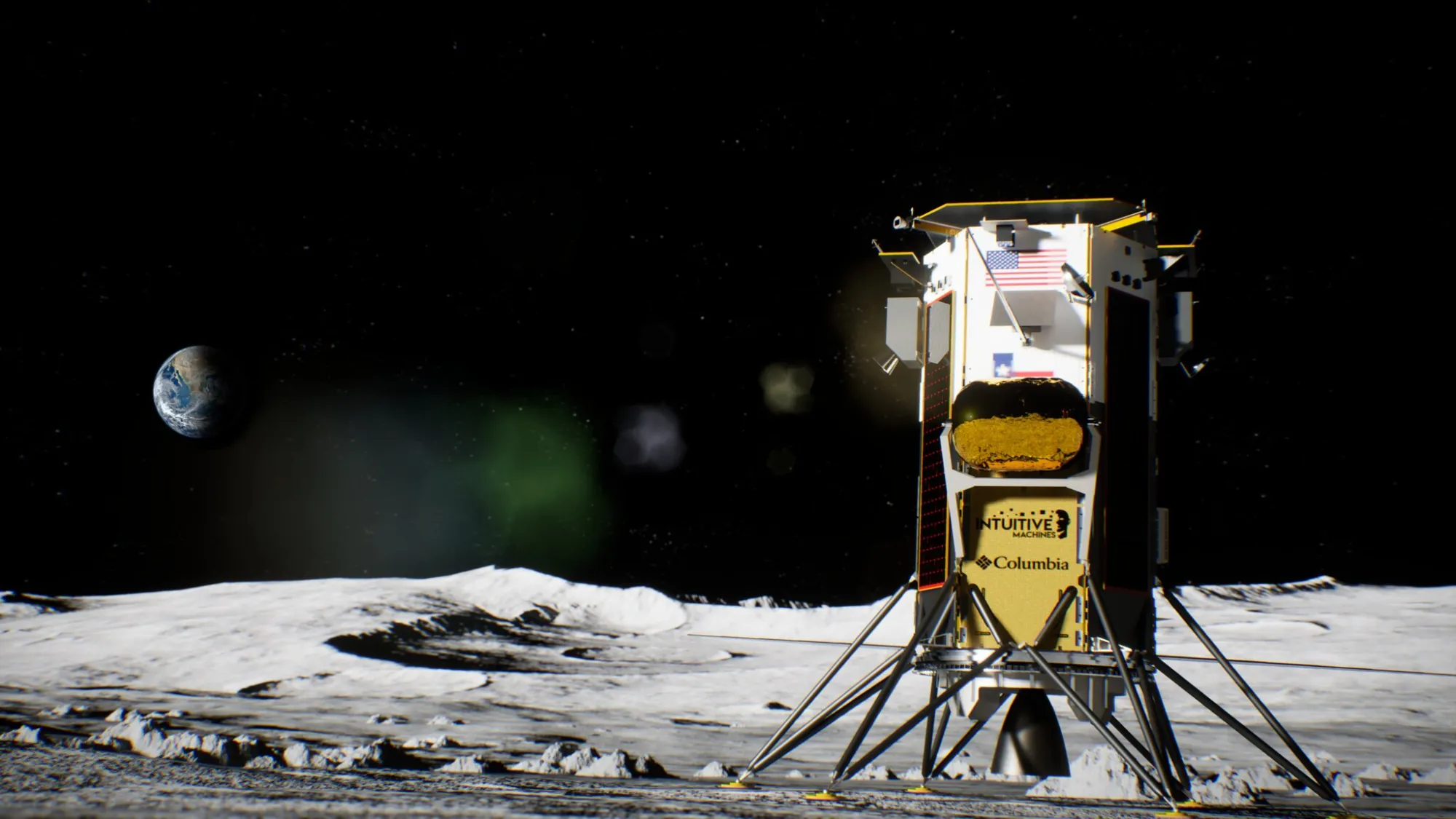

That’s right, folks. Intuitive Machines’ Nova-C class lander, dubbed Odysseus, has successfully landed and is upright on the lunar surface. After a few harrowing moments of questioning whether the lander had, in fact, landed, they announced proudly to their back room in Houston that “Odysseus has a new home.”

Now, we’re still waiting for official photo release from the lander (and, critically, the EagleCam photos of landing, but more about the payloads later), but Intuitive Machines has announced that downlinking is in progress, so after a while, this article may be updated with those images.
This is monumental for a number of reasons.
First: It validates NASA’s model with the new CLPS program (for more on that, see our last article about IM-1 and CLPS here.), as the cost for IM-1 was around $118 million — around 10-20% of what it would’ve cost NASA to build a dedicated lander themselves, plus IM-1 also contained another half-dozen non-NASA payloads (I’ll talk about payloads in a bit here).
Secondly: It’s the first time an American-built spacecraft — and a spacecraft built by a private company — has successfully landed on the Moon in over a half century. The last time an American lander landed on the Moon was December, 1972, when Apollo 17 landed on the Moon.
Third: It’s the first landing in the South Pole region of the Moon. Malapert A, a sub-crater of the larger Malapert Impact Basin, is somewhere around 80 degrees South in latitude.
Okay, so off to talk about payloads (and continue to eat time until the photos release).
IM-1 has a dozen payloads, and I’m going to try to talk about each of them very briefly (information pulled from the Intuitive Machines website).
NASA Payloads:
- RFMG: Radio Frequency Mass Gauge. This instrument is not so much a scientific instrument as an engineering testbed. It’s designed to be a fancy fuel sensor for being able to tell how much fuel is in your tanks without having to waste precious fuel by thrusting in a certain direction and seeing how much force it imparts.
- SCALPSS (Stereo Cameras for Lunar Plume-Surface Studies): This is a set of four cameras designed to study the interactions between the lunar surface and the lander’s methalox engine plume.
- ROLSES (this one has a really long acronym): It’s a radio system designed to measure interactions between cosmic rays and the thin lunar exosphere. This serves as a pathfinder to potential lunar radio astronomy.
- NDL (Navigation Doppler LIDAR for Precise Velocity and Range Sensing): This name refuses to match its acronym… NDL is a payload that uses lasers to guide the lander’s descent to enhance precision landing.
- LRA (Laser Retroreflective Array): Now, retroreflective sounds like something straight out of Marvel’s Avengers (The Helicarrier, anyone?), but it’s essentially a fancy set of mirrors that can be used by future landers as a waypoint for laser-based navigation. The more of these there are around a specific area, the more points a future lander has to cross-reference its position, since lunar GPS doesn’t exist (yet).
- LN-1 (Lunar Node 1 Navigation Demonstrator): This payload is designed to support autonomous satellite positioning as a radio beacon. Unlike the LRA, LN-1 is an active experiment, rather than LRA being a passive experiment. However, they both serve a similar, as pathfinders to future landers.
Non-NASA Payloads (Commercial Payloads)
- Lunagram (Lunaprise): Similarly to the Voyager golden records, this passive payload serves as time capsule, containing information about the Earth today. It is possible to be removed, meaning that it could be removed by some future astronauts on EVA, which is a neat touch!
- Moon Phases Art Cube: 125 miniature moons (in an NFT project, yes, yes, someone paid money for this.) designed to show how sun and shadow “carve on the moon into phases.” Their words, not mine.
- Omni-Heat Infinity (Columbia Sportswear): Yes, apparently the thermal protection counts as a payload. I mean, Columbia paid good money to not only have their name plastered on the spacecraft, but in a very visible spot… and it worked well, so that’s some pretty good publicity for this stuff. It kept liquid methane cold for the full trip out. Well done, Columbia!
- Lonestar Lunar (Lonestar Data Holdings): As far as I can tell, this is a massive data bank holding information in it. This may be tied into the operating system, or it could be just a digital repository of information, like a preservation move. I don’t entirely know, it’s rather nondescript on the website.
- EagleCam (Embry-Riddle Aeronautical University, Daytona (FL) & Prescott (AZ) campuses): This instrument was designed to be ejected from the lander at about 30m altitude, where it would take pictures of the lander, well, landing. It’s to be determined if it worked yet, but we’re going to find out very soon! (Hopefully. I continue to make this article longer praying that they release these photos.)
- ILO-X (International Lunar Observatory Association): A precursor to the aforementioned polar Lunar Radio Observatory, dubbed ILO-1 by the association, it contains a suite of cameras designed to take the celestial observations from the lunar surface of the Milky Way, Earth, and more.
Okay, I don’t think I can push this article any longer than this. I’m sure that by the time it actually gets published, Intuitive Machines will have released their own images and the stuff from EagleCam and I’ll look the fool… oh well.
Update: Feb 23rd, 0900 CST
Intuitive Machines put out another tweet this morning. Odysseus continues to gather science data and has good telemetry and solar charging. IM CEO Steve Altemus will be partaking in a press conference at some point today (exact time TBA), where they will likely release the first images.

Hey, y’all! I’m Ethan, I go by Beagle, and I write space. I am a part of the Max-Q News team, as well as one of two hosts for the Max-Q Podcast!

Leave a Reply