
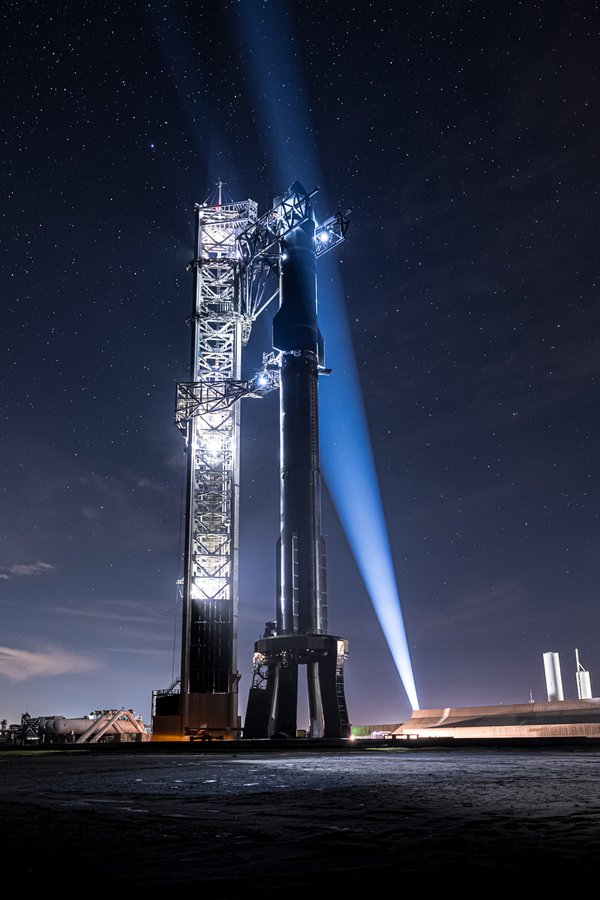

Early yesterday morning, SpaceX’s massive Starship vehicle made a triumphant return to flight. On November 18th, 2023, at 7:03 local time, Superheavy Booster 9 (B9) roared to life, lifting it and Starship 25 (S25) off the pad for another try at reaching space. And this time, they made it.

Credit: John Kraus
The flight down in Starbase started off textbook, with B9 successfully igniting, throttling up, and running all thirty three of its powerful raptor engines to lift off. All 33 engines continued to run as the rocket ascended. The rocket reached Max-Q (where aerodynamic forces on the vehicle are strongest) and passed with flying (pun intended) colors.

Credit: NasaSpaceFlight/Max Evans
The booster continued to propel the ship upward through its full duration, reaching MECO (Most Engines Cut Off) at T+2:45, at an altitude 73 kilometers. What followed was a the main goal for the entire flight, and a first for SpaceX: successful stage separation and ship engine ignition.

Credit: SpaceX
The booster then began to flip around and perform its boostback maneuver, where the center cluster of raptors would propel the booster back towards Starbase, stopping just shy so that the booster would simulate landing in the Gulf of Mexico. Unfortunately, B9’s luck ran out as raptors began shutting down during this maneuver and ultimately resulted the the booster experiencing a rapid unscheduled disassembly (RUD).

Credit: John Kraus
Unaffected by the booster explosion, S25 continued on its burn, with the goal of getting on a just barely suborbital trajectory ending in a reentry over Hawaii. Following in its footsteps, S25 successfully lit all 6 engines during stage separation and kept them running all the way through its burn duration until just before it was intending to cut them off. At T+8:05, S25’s engines suddenly cut off and telemetry ceased. The final reported numbers were an altitude of 148 kilometers, and a velocity of 24,122 kilometers per hour. Nominal engine cutoff (SECO) was intended for T+8:33, just under 30 seconds after the ship was seemingly lost.

Credit: SpaceX
Overall, and especially in regard to the first flight, yesterday was a massive success for SpaceX. Every issue that rose from the first flight had been addressed and successfully mitigated. Not only that, Starship reached even greater heights and actually made it into space, the first time a Starship vehicle as ever done so. The launch site, which was borderline destroyed last flight, looks to be no worse for wear other than a few scorch marks. SpaceX is now in a great position to build off of this flight for IFT-3, which could come very soon.

Leave a Reply