
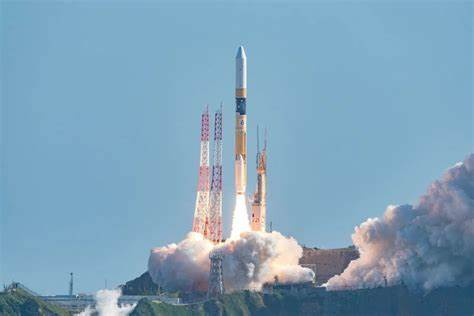


JAXA had a gorgeous launch on early in the morning of September 7th (8:42 AM JST) of their Return to Flight mission following the loss of the inaugural H-3 rocket early this year. The H-IIA rocket lifted off from the pad at Tanegashima Space Center about 10 days late, following a pair of weather-related delays. This marked the 47th launch of an H-IIA rocket, and the 46th success.
The rocket carried a pair of payloads, a rare feat for JAXA, and an even rarer instance when you observe where the payloads are each heading to — or have arrived at.
The first payload was the XRISM (pronounced crism) satellite–the X-Ray Imaging and Spectroscopy Mission. Designed as a replacement for the failed Hitomi mission (also operated by JAXA), XRISM is an X-ray satellite built to operate alongside the still-operational Chandra and XMM-Newton missions (both NASA), both rapidly aging satellites launched in the 90s, and designed to fill the dozen-year gap until the launch of the (currently) most-powerful X-ray space telescope designed yet, ATHENA (being designed by ESA).

XRISM will, like Chandra, Newton, and ATHENA, operate in low Earth orbit, and be observing “soft” X-rays, i.e. higher-wavelength X-rays, closer to that of visible light.
The other payload onboard the mission is SLIM, the Smart Lander for Investigating Moon. This is a small lunar lander designed to test an accurate lunar landing software sometime in January 2024 following a long, ballistic coast phase.

SLIM will attempt to become the first successful Japanese lunar lander after multiple failed attempts, including the recent Hakuto-R mission. If successful, Japan will become the fifth country to ever successfully land on the moon, following the US, Soviet Union, China, and (earlier this year) India.
SLIM is currently in a parking, transition orbit on its way to its initial Trans-Lunar Injection, which will catapult the spacecraft far beyond the Moon, where it will make a four-month-long journey to catch back up to it at a much lower velocity, allowing for a lower velocity for capture.
XRISM is currently in activation mode and should be fully operational by the end of the year.
All photos used under Creative Commons 4.0.

Leave a Reply