
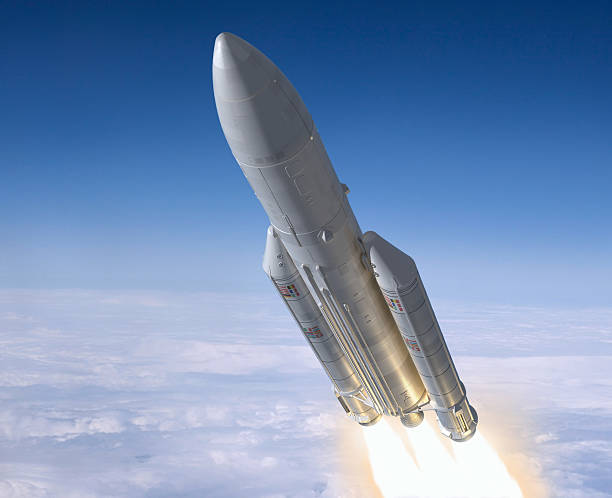

On July 6th, 2023, Ariane 5 successfully launched for the final time, ending a nearly 3 decade run for the rocket. In this article, we will examine the specifications and history of the rocket, notable launches (including its final payload), and what Arianespace, the company behind the vehicle, has planned for the future.

The Ariane 5 rocket is a heavy lift vehicle operated in Europe by the European Space Agency (ESA). The rocket operates using a combination of both a cryogenic engine (Vulcain 2, hydrogen and oxygen; hydrolox) and two solid rocket boosters attached on either side utilizing a 68/18/14 oxidizer, fuel, binder ratio of ammonium perchlorate, aluminum, and polybutadiene respectively. The upper stage is followed by a cryogenic upper stage utilizing the same propellants as the Vulcain 2, but vacuum optimized, known as the HM7B engine. It was able to launch 10 metric tons to Geostationary Transfer Orbit (GTO) and 20 metric tons to Low Earth Orbit (LEO). It also housed space for two passenger payloads to be deployed highly accurately, a staple of the Ariane rockets that dates back to 1980.
This is the most recent configuration, called the ECA (Evolution Cryotechnique A). However, the rocket does have slightly different configurations in its past. The original version of the Ariane 5 was dubbed the Ariane 5G (The G standing for Generic). This was then updated to the 5G+, which had improved the second stage propulsion system. While these rockets were in place, the ECA was being developed, but due to a failure in the rocket in 2002, some of the proposed ECA fitted rockets were outfitted with modified cores to utilize the G+ propulsion systems, creating the GS. Finally, the ECA was tested successfully and put to use. There was also an ES (Evolution Storable) configuration, which provided the ability to restart the second stage through a modification from the original second stage in the rocket. There was also a proposed ME configuration (Mid-life Evolution) that was being developed, but resources for the project were put towards the Ariane 6 in 2014.

While we see the vehicle as successful and integral to certain missions now, there were a few mission failures that were present in the earlier days of the spacecraft. One such failure was the maiden flight of the Ariane 5 in 1996; a mission ending failure caused by a computer error. The rocket utilized code from the inertial reference platform from the Ariane 4, but the code was not updated with the new formats of Ariane 5, particularly the mission profile of the rocket. The Ariane 5 operated with higher horizontal velocity values than the Ariane 4, which was not tested for when the software was reused, leading to the rocket to have unnaturally high horizontal speeds in comparison to what the Ariane 4 code was designed for. This also led to the values of the speed, stored as 64-bit floating point number, to be converted to signed 16-bit integers, leading to an overflow hardware exception. The code was not protected from this specific overflow error, which led to the inertial reference platform freezing and sending diagnostic data to the main computer, which was incorrectly interpreted as flight data and set the engines in off-nominal positions and separating the boosters, triggering the self-destruct mechanism on the flight.

However, the rocket was able to continue in its development and become the launcher it is known as today. One notable launch is 2018’s BepiColombo, the Mercury orbiter and observation satellite that is expected to arrive in 2025. A fascinating probe that is utilizing the gravitational assistance of Venus, Earth, and a few orbits of Mercury itself to be captured by the gravitational influence of Mercury. What makes this maneuver difficult is that Mercury is a small planet, which means its gravitational strength is low; this is contrasted, however, by being right next to the Sun, which has a much larger effect on gravity, especially considering how close Mercury is. This means that the insertion of BepiColombo must be very precise to just be trapped by Mercury’s gravity, while avoiding or limiting the effects of the Sun’s natural gravitational pull. Another notable launch was 2004’s Rosetta and the additional lander Philae. This satellite and lander duo made history by being the first satellite to orbit a comet, and the first lander on a comet’s surface respectively. Unfortunately, the lander suffered a harder landing than was planned and was masked by a cliff, causing it to lose power in a few days, but the orbiter was able to get many high detail shots of the comet that were previously never seen. And finally, perhaps the most well-known success story from the Ariane 5 is the Christmas 2021 James Webb Space Telescope. This telescope is the largest and most powerful space telescope ever to be launched, capable of seeing in the infrared light range to capture light from the beginnings of the universe. The telescope infamously had 344 single points of failure, of which many of them were related to the revolutionary unfolding “origami” technology that was used to launch the telescope more compactly. What was special about the telescope’s relationship with the Ariane 5 was how well the rocket had placed the telescope on its trajectory, nearly doubling the lifespan from 10 to 20 years of use, a wonderful boon to all the scientists excited to utilize the instrument. Ariane 5 achieved this by being the “best of the best” of all its parts. Certain components, such as specific manifolds and the engine itself, were selected because of their exceptionally precise behavior during testing, culminating in the telescope’s extension of life through the rocket’s phenomenal accuracy. In its final flight, the Ariane 5 launched two satellites, a communications satellite for Germany (H2Sat) and a military satellite for France (Syracuse 4B). The launch went smoothly, lifting off at 6:00 PM ET and just over 30 minutes, marking a successful end to the rocket’s 27-year long service.

So, what’s in stock for the future? Arianespace (or more specifically, the ArianeGroup corporation, which also includes Airbus and Safran) is building the Ariane 6, a space launch vehicle more powerful and efficient than the Ariane 5. Of which there are 2 variants being worked on: the Ariane 62 for scientific missions and 64 for commercial missions. The 64 will include 4 solid rocket boosters as opposed to the usual 2 in the 62. The upper stage will also be hydrolox powered.

The Ariane 5 was truly a wonderful rocket. Boasting incredible accuracy and precision, the launch vehicle was behind some of the most important scientific and commercial missions to better connect humans and continue exploring the stars.

Leave a Reply