
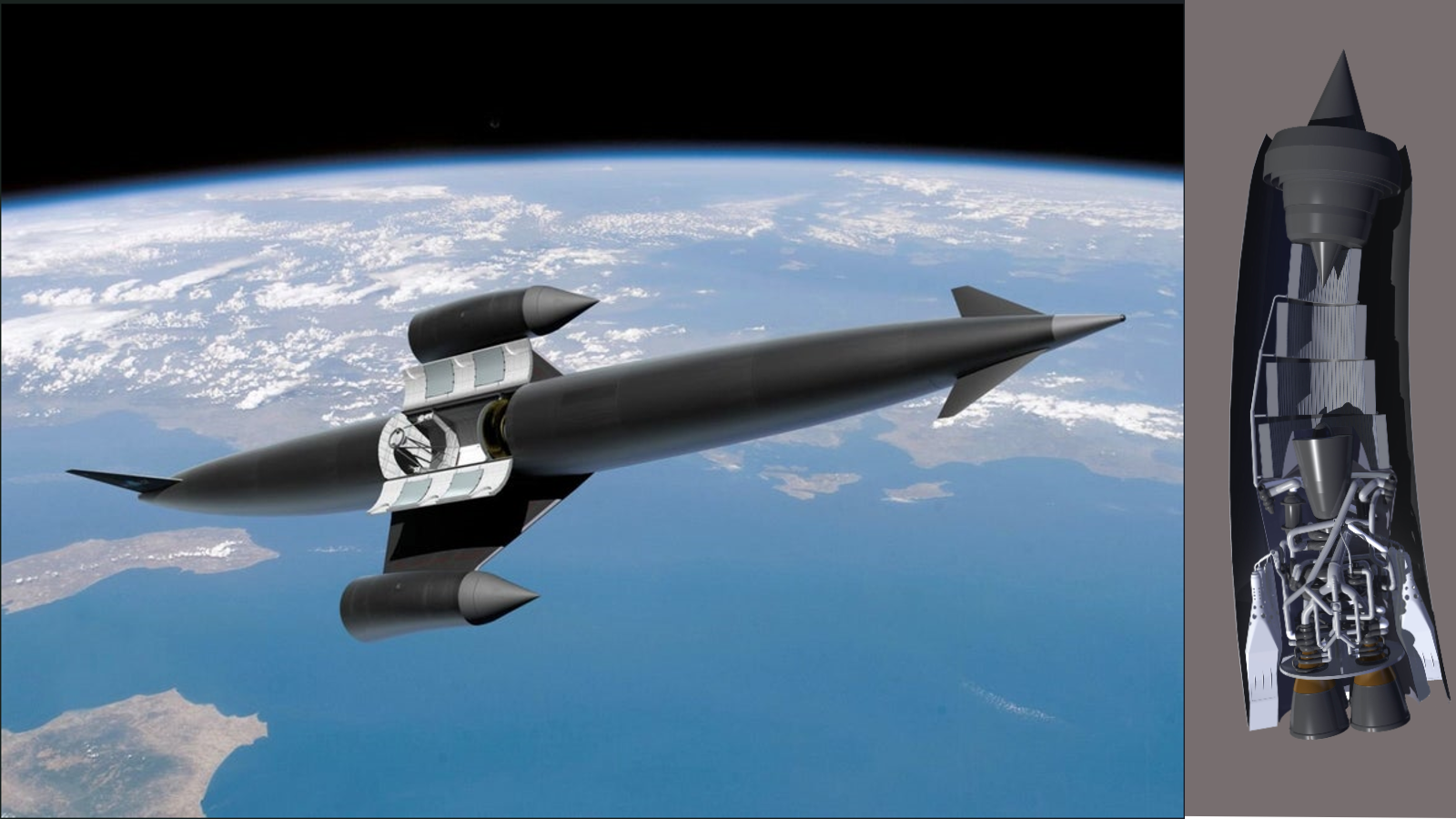
Breaking barriers, and potentially even the laws of physics, the Skylon SSTO project by Reaction Engines Ltd. could bring Great Britain back into space, or sink it deep into the ocean.

Oxford, England — Ever since the collapse of the Black Arrow project (After it successfully reached orbit, for whatever reason), Britain has been itching to get back into the space market. Several startups, and even a certain red, air-launched rocket by a certain crazy billionaire, have tried and failed to claw Britain back into the space industry the hard way. A company based out of Oxford, England; famous for Oxford University, being the home of 28 Nobel Prize laureates, and of course the home of the MINI car factory, has chosen a slightly different approach to space.

Britain has certainly produced some very interesting figures, but I never thought an SSTO would be one of them. Skylon is a proposed reusable spaceplane designed to be the world’s first Single Stage To Orbit (SSTO) vehicle. Developed by the British aerospace company Reaction Engines Limited, Skylon aims to revolutionize space travel by providing a more affordable and reliable means of accessing low Earth orbit. The spacecraft is designed to take off and land like a conventional aircraft, which makes it an ideal solution for routine access to space. Skylon certainly has the potential to transform the space industry and open up new frontiers in space exploration. Still, its deep and interesting history, as well as the laws of physics, could put a damper on that.
Cancelled!
Skylon is a British SSTO that initially came out of the HOTOL program, which was initially a project which developed a Horizontal Takeoff and Landing vehicle, similar to that of the Space Shuttle. The difference here is that the vehicle would be an SSTO, meaning no extra stages are spent getting the vehicle into, or out of, space.
Following its cancellation by the kings of cancelling nearly complete cutting-edge aerospace programs, the British Government, many of the people who worked on it started a company called Reaction Engines Limited. The Skylon project was announced to the public in 1993, it used many of the technologies developed for HOTOL, but was a completely redesigned vehicle to address many of the problems that came with the initial HOTOL project. More about this later.
Engine Innovation

In its current D1 iteration, Skylon uses two SABRE MK. 4 engines, a marvel of engineering in its own right that rivals the Pratt & Whitney J58 of the SR71 Blackbird. This engine is a combined cycle rocket that’s essentially a hybrid of a “conventional” ramjet and rocket engine. The SABRE (Synergetic Air-Breathing Rocket Engine) works in two distinct modes, not too dissimilar to the R.A.P.I.E.R engine from the Kerbal Space Program game series:
The first mode is the Air Breathing mode. While in high-speed atmospheric flight, the air around the plane heats up to almost 1000C. Mixing superheated air with Liquid Hydrogen is obviously not going to work without some extra steps, which is why a precooler is used to chill the air from 1000C down to -150C using gaseous helium. This almost-liquid-oxygen air mixture is then fed into the rocket’s combustion chamber where it is ignited with Liquid Hydrogen which is stored onboard the vehicle. The high pressure ratio that comes from cooling such high-energy air means that the engine can provide high thrust at high speeds and altitudes, while the low temperature of the compressed air means that light alloys can be used in the construction of the engine, which is an essential part of helping this spaceplane reach orbit.
The second mode is the Closed Cycle mode. Activated at around Mach 5.14, at an altitude of around 28.5km, the engine can start to use Liquid Oxygen rather than the ram-compressed air from the atmosphere, which allows the spaceplane to run in the thinner parts of Earth’s atmosphere. In this mode, the spaceplane will be in a steep climb, which allows it to gain enough altitude to stay out of the atmosphere long enough to complete an orbital insertion burn and circularization burn.
So many innovative systems are used onboard SABRE that this article would be far too long to read if I included all of them, so here is a few of the technologies that SABRE incorporates:
- Modified turbo-compressor – While the vehicle is below Mach 5 and 25km, the cooled air from the precooler passes into a modified turbo-compressor, similar to those used on regular jet engines but running at a high pressure ratio made possible by the low temperature of the inlet air. The compressor feeds the compressed air at 140 bar (2030 psi) into the combustion chambers of the main engines
- Helium Loop – The heated helium from the air precooler is recycled by exchanging the heat with the liquid hydrogen in order to vaporise the hydrogen for use as fuel in the combustion chamber. The cooled helium can then be used to chill critical parts of the engine and power turbines, which makes this engine a self-starting Brayton cycle engine.
- Combustion chamber cooling – Rather than using the cool helium as mentioned in the previous paragraph, or liquid hydrogen from the tanks, the combustion chamber is actually cooled using the chilled air/liquid oxygen (depending on what mode the engine is running in). This reduces the system’s use of liquid hydrogen when compared to stoichiometric systems.
- Dynamic nozzle – The nozzle of the engines can be adjusted in flight to increase efficiency in high altitude and vacuum flight, but can also be shortened to reduce flow separation at low altitudes.
I could write forever about SABRE, but if you want to dive even deeper into the engine, you can find its Wikipedia article here.

Project Revival
In 1989, after the cancellation of the HOTOL program, Alan Bond, John Scott-Scott, and Richard Varvill founded Reaction Engines Limited to develop a spaceplane and related technology with private funding. In 1993, they announced their proposal, named Skylon, the SABRE engine mounted on each wing to deliver thrust. Reaction Engines Limited then attempted to secure funding from the ESA and sought government or commercial investment. Over the years, a few companies have invested in the Skylon project, such as BAE Systems, Boeing and Rolls Royce, and the British government have granted Reaction Engines Limited up to £60mn towards the development of the SABRE engine.
Will it ever take off?
Reaction Engines Limited estimated in 2011 that they would require $12 billion to achieve an operational configuration of their spaceplane by 2020, which obviously hasn’t happened. It looks like Skylon is struggling to receive enough government funding to make it off the ground, and for now, Reaction Engines Limited is focusing on developing the SABRE engine after receiving a DARPA contract to conduct high-temperature airflow testing at a facility in Colorado. Testing of the SABRE’s precooler is still ongoing as of July 2022.
Sadly, it looks like Skylon may not come to fruition for a long time, as the development of the SABRE engine has been slow and painful, which is to be expected for an engine that challenges so many new frontiers.
There are several challenges that make the development of a single-stage-to-orbit (SSTO) spaceplane difficult. One of the biggest issues is the need to carry enough fuel to achieve orbit, which adds significant weight to the vehicle. This makes the vehicle heavier and more complex than a traditional two-stage rocket, which can drop off stages as they burn out. Additionally, SSTOs must carry the weight of their own engines and fuel, while also carrying the payload they are launching. This results in a difficult balancing act between the weight of the vehicle and the amount of fuel it can carry, making it challenging to achieve the necessary speed and altitude to reach orbit. The heat generated during reentry can also be a major challenge, as the vehicle must withstand high temperatures and forces while also being light enough to fly. These issues have made it difficult to develop a fully functional SSTO spaceplane, and Skylon has been no exception to this.
Hey, I’m Divaze (Div-ahh-zay). I’m a writer for Max-Q News by day, and a qualified SCUBA Diver by night. I love feeling weightless, and exploring other-worldly environments, which is why I am interested in both diving and space!
April 13, 2023

Leave a Reply