
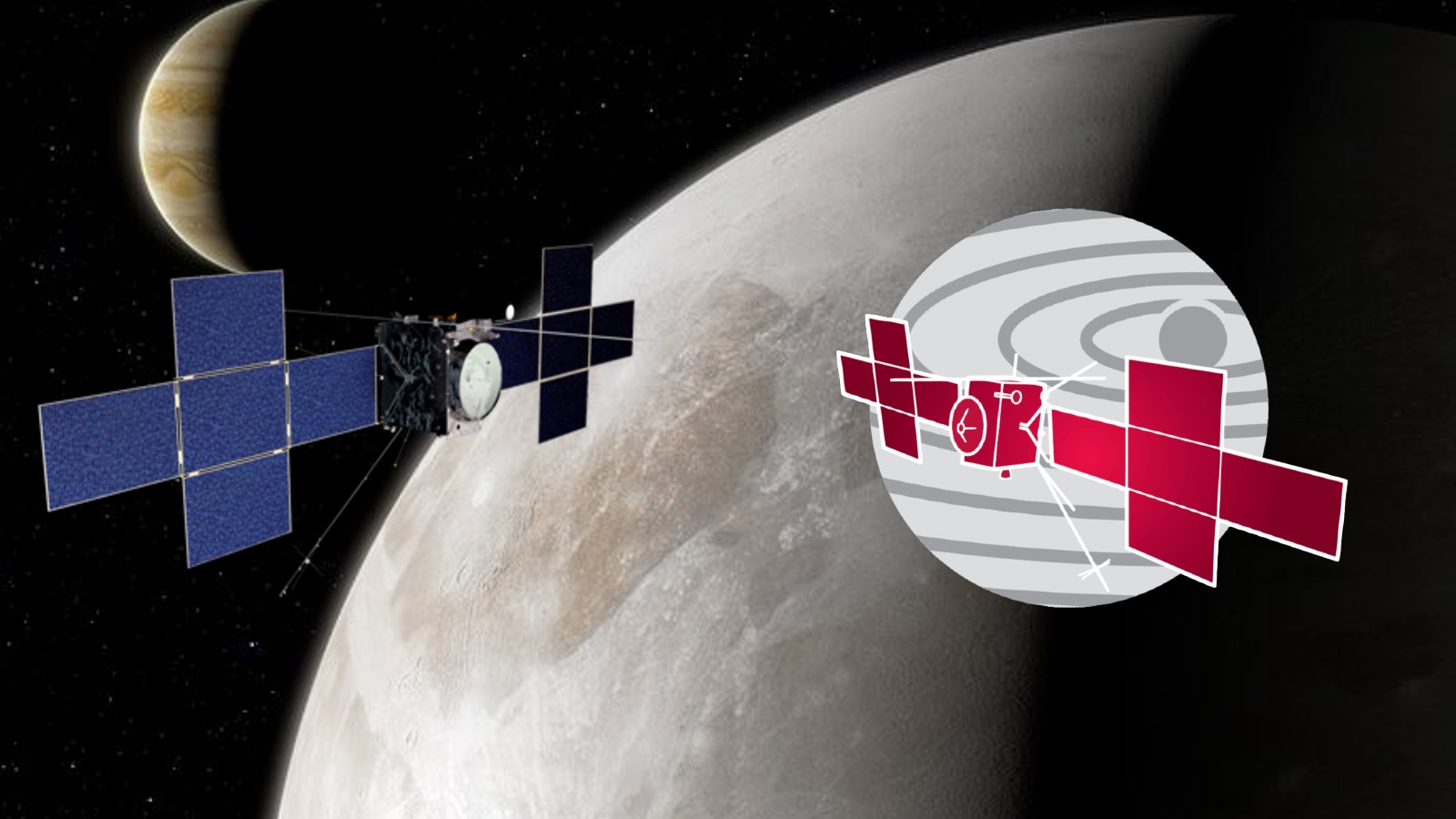
The ESA’s latest probe is set to delve deep into the mysteries of Jupiter’s moons, uncovering secrets that could change our understanding of the outer planets.

Kourou, French Guiana – the JUICE (JUpiter ICy moons Explorer) spacecraft is the next in line to escape Earth’s gravity well and venture into the depths of interplanetary space. JUICE is set to begin a decade-long voyage to the orange planet this month, with its launch atop an Ariane 5 heavy-lift rocket scheduled on the 14th of April 2023, however this is subject to change.

Painfully long journey ahead!
Following the launch, a few events happen in quick succession before a rather long coast. JUICE already arrived in French Guiana earlier this year, with launch preparations commencing shortly after. Once JUICE is lofted into space, teams will make contact at around T+32 minutes, with JUICE’s 85 square-meter solar arrays unfurling at T+99 minutes. Because of the inverse square law affecting the performance of the solar panels, and the huge distance between the Sun and Jupiter, they need to be large enough to power the spacecraft. Funnily enough, these panels are the largest solar arrays ever flown on an interplanetary spacecraft, which is unsurprising considering how far away JUICE will be venturing from our star.
Once the solar arrays are out, JUICE will deploy several instruments such as a magnetometer, antennae and other electronics between T+16 hours and T+17 days. Because Ariane 5 is not powerful enough to place JUICE on a direct encounter with Jupiter, the probe will use a series of long and complicated gravity assists to raise its velocity. During a gravity assist, the spacecraft approaches a planet and uses its gravity to gain energy and accelerate, while the planet or moon loses an extremely small amount of energy and slows down very slightly. This change in velocity allows the spacecraft to alter its course and direction without the need for additional fuel or propulsion. Gravity assists are very commonly used during missions to the outer planets, as it saves fuel and reduces travel time. These maneuvers have been used in numerous missions to explore our solar system, including the Voyager and New Horizons missions.


JUICE will actually be making it’s first stop at home, where it will have a Lunar-Earth flyby by around August 2024. Following that, JUICE will fly past Venus exactly one year later, and then two back-to-back encounters with Earth in September 2026 and January 2029. Finally, once all of those gravity assists are complete, JUICE should arrive at the Jovian system in July 2031.
As well as these exciting encounters, teams are currently evaluating the possibility of JUICE performing a flyby of the “223 Rosa” Asteroid. This flyby would take place during the final coast of the mission, and if teams opt to fly past this asteroid, it would serve as a dress rehearsal for the upcoming icy moon flybys.
Let the science begin!

JUICE will jump into action straight away, performing flybys of 35 icy moons between July 2031 and November 2034. This is JUICE’s primary purpose, with 10 different instruments being used to determine whether a liquid ocean exists under the icy crusts of Jupiter’s three icy moons, Ganymede, Callisto and Europa.
The JUICE mission has been primarily designed around the themes of ESA’s Cosmic Vision programme, “What are the conditions for planet formation and emergence of life?” and “How does the Solar System work?“. JUICE’s primary objective is to study the factors that could have contributed to the formation of habitable conditions on Jupiter’s icy moons, with particular attention given to the three worlds with subsurface oceans: Ganymede, Europa, and Callisto.
Ganymede has been singled out for closer examination as it offers a natural setting for analyzing the characteristics, development, and potential habitability of icy moons in general. Additionally, Ganymede’s unique magnetic and plasma interactions with Jupiter’s environment, as well as its significance in the Galilean satellite system, make it an ideal target for in-depth investigation.
The main science objectives for Ganymede and Callisto are:
- Characterisation of the ocean layers and detection of subsurface water reservoirs
- Topographical, geological and compositional mapping of the surface
- Study of the physical properties of the icy crust on Ganymede and Callisto
- Characterisation of the internal mass distribution, dynamics and evolution of the interior of Ganymede and Callisto
- Investigation of the exosphere of Ganymede and Callisto
- Study of Ganymede’s intrinsic magnetic field and its interactions with the Jovian magnetosphere.

The JUICE mission has also designated Europa as a significant area of interest for several reasons. One of the key goals is to study the chemistry that could potentially support life, with a particular focus on the presence of organic molecules. Additionally, researchers hope to gain a better understanding of how the moon’s unique surface features formed and to analyze the composition of the non-water-ice material present on the surface.
However, the JUICE mission is not solely focused on surface-level investigations. In fact, one of the most exciting aspects of the mission is the opportunity to conduct the first-ever subsurface sounding of Europa. This will enable researchers to determine the thickness of the icy crust covering the most recently active areas, a critical piece of information for understanding the moon’s geological activity and potential habitability. With the unprecedented level of detail that JUICE will provide, scientists hope to unlock new insights into the complex processes at work on Europa and gain a deeper understanding of the role this enigmatic moon could play in the search for life beyond Earth.
Image caption: An artist’s impression of JUICE visiting Jupiter. Credit: ESA
Following the completion of its mission around Ganymede, JUICE is expected to deorbit itself into Ganymede’s surface, unless evidence of a liquid ocean is found, in which case, teams will reevaluate its future.
Hey, I’m Divaze (Div-ahh-zay). I’m a writer for Max-Q News by day, and a qualified SCUBA Diver by night. I love feeling weightless, and exploring other-worldly environments, which is why I am interested in both diving and space!

Leave a Reply