
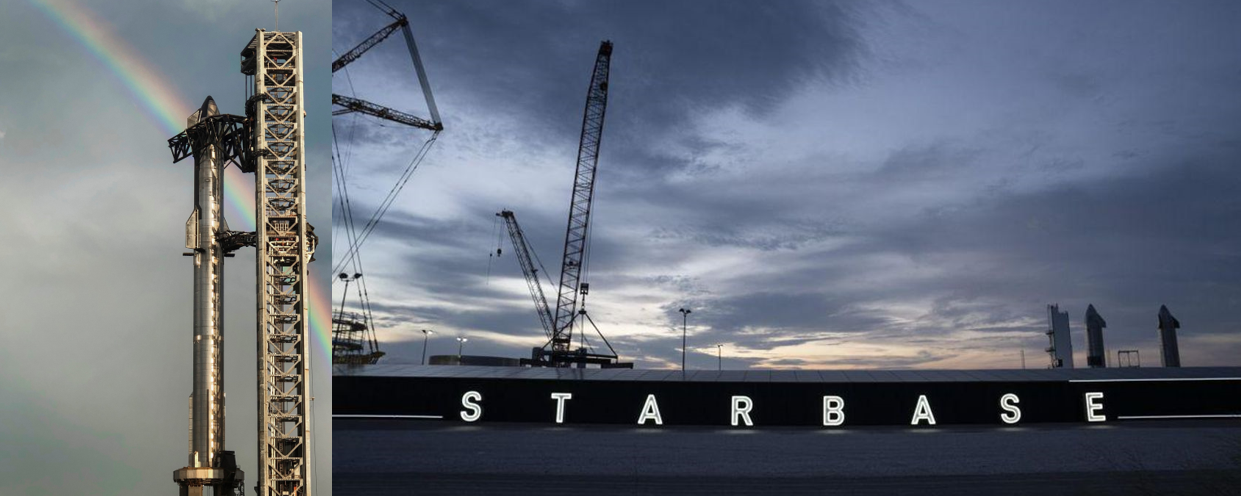

Exciting things are happening down at Starbase, SpaceX’s most ambitious launch site, as final preparations are underway on B7 and S24 ahead of the maiden flight for the Starship launch vehicle. If successful, starship will be the largest and most powerful rocket ever launched.
Target Launch Date
Currently SpaceX is targeting April 17th, 2023 at 7:00am CDT for the Integrated Flight Test. Times can change, so follow SpaceX on twitter for the most up to date information. The launch window opens at 7:00 am CDT and lasts until 11:00am CDT.
Countdown To Launch
Leading up to T-0, SpaceX must perform a serious of vital steps before they can light all 33 raptors on B7. SpaceX has posted the countdown process on their website, starting from T-2 hours when the flight director polls for propellant loading. If the poll is GO, the teams will then begin loading liquid methane (LCH4) and liquid oxygen (LOX) into booster first, and then the ship. Once prop load is complete, the chill down sequence for the booster’s engines begins at T-16:40. This step is important to prime the raptors for ignition, as they need to be chilled beforehand in order to successfully ignite without being damaged by temperature shifts. At T-8 seconds, the raptor ignition sequence starts, where all 33 engines will startup in a staggered manner in order to control the forces on the launch mount. Once all raptors are lit and ready to go, the clamps on the launch pad release, and Starship will lift off for the first time.

Post Liftoff
As exciting as it may be, liftoff is only the beginning of this test. Once it clears the tower, it has a series of milestones to pass during ascent. The first of those milestones is max Q, which is the maximum aerodynamic pressure the vehicle will experience on ascent. This will occur shortly after liftoff at T+55 seconds. Following max Q, Booster main engine cutoff (BECO) will occur at T+2:49. This is where Booster 7 will cutoff all 33 of its Raptor engines in preparation for stage separation at T+2:52. Once stage separation occurs, two things will happen in quick succession; Starship ignition at T+2:57, and Booster boost back burn. Following stage separation B7 will flip itself, and ignite 13 of its raptor engines to preform a boost back burn at T+3:11. Booster 7 will descend through the atmosphere before preforming its landing burn at T+7:40 for a splashdown in the gulf of Mexico. Back to S24 it will burn for about 7 minutes before entering its coast phase.

Flight Path
Following liftoff Starship will begin pitching down range over the gulf of Mexico. Once the booster and ship separate B7 will begin its descent down to its splashdown site in the gulf of Mexico. While B7 is descending, S24 will continue its path to its splashdown zone just off the coast of Hawaii. It is important to note S24 will not be doing its flip and burn maneuver; if it survives reentry it will be bellyflopping into the Pacific Ocean, being destroyed upon impact.
Final words
From the early days of SpaceX with the Falcon 1 and the original Falcon 9, to the first landing of an orbital booster, and the first flight of the Falcon Heavy, SpaceX has been an inspiration to all around the globe. From all of us at MaxQ, we wish SpaceX the best of luck with arguably one of the most important launches of this century. Good luck, and god speed!

Leave a Reply