
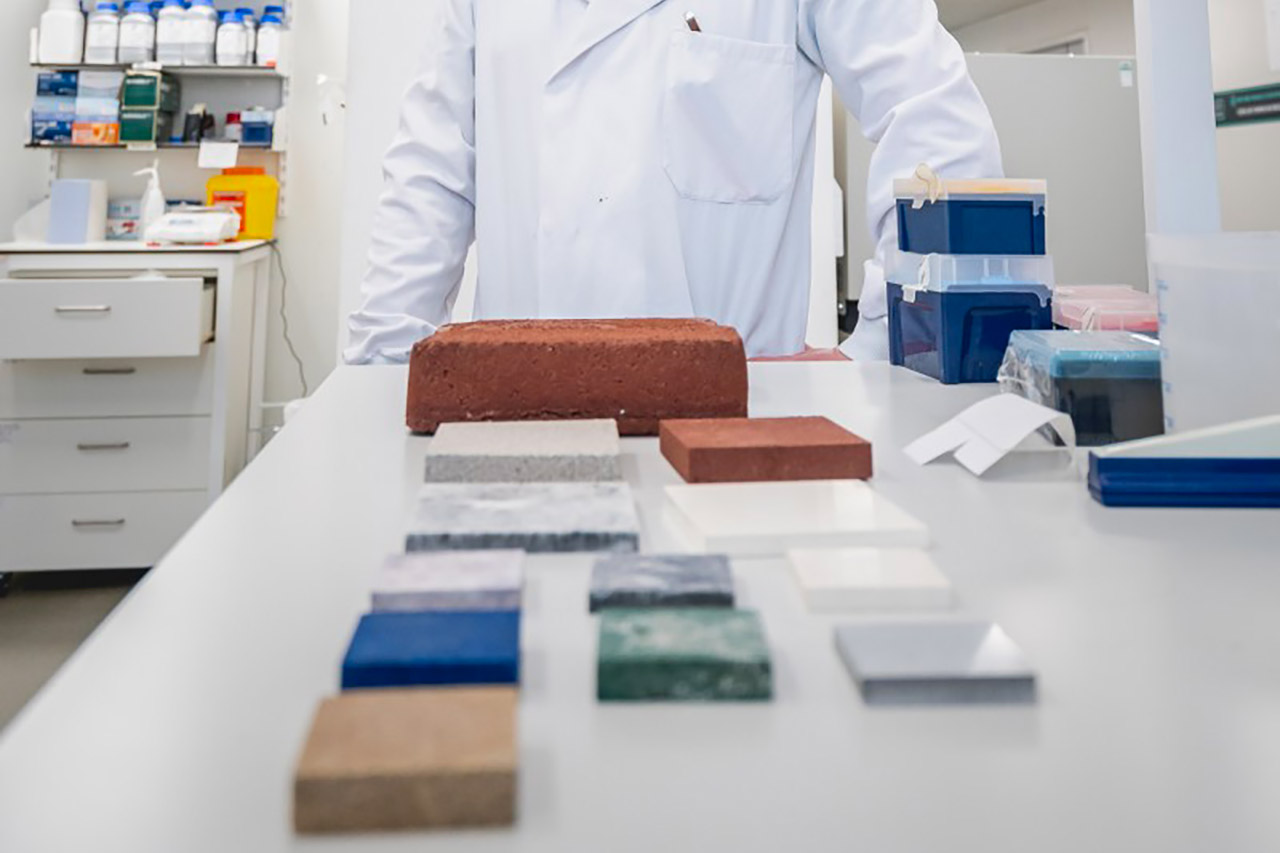

A research duo from the University of Manchester and Future Biomanufacturing Research Hub have created a synthetic mixture using starch and regolith from the Moon and Mars that tested to be more than twice as strong as “Earth” concrete.

In March, research authors Aled D. Roberts and Nigel S. Scrutton published a paper in the journal Open Engineering, detailing the process and subsequent testing of this new material.
StarCrete is created using very simple processes that required very low energy and complexity. First, the regolith was mixed with powdered potato starch. The mixture is then gelatinized with magnesium chloride salt (MgCl2) by hydration and heating. The resulting gel-mixture of StarCrete is allowed to partially dry and were then molded and compressed into bricks. This allows the starch to act as a binder and glue the entire substance together as it hardens. The bricks are fully dehydrated and produce a finished brick of StarCrete! The paper included an infographic on the general process, shown here:

These bricks were tested alongside regular concrete to provide a comparison of strength. Scrutton and Roberts found that StarCrete of both martian and lunar regolith were remarkably stronger than regular concrete used on Earth. Martian StarCrete has a compressive strength of 71.95 megapascals (MPa). Lunar StarCrete is even stronger, at 91.68 MPa of compressive strength. For reference, regular concrete has a compressive strength of about 32 MPa. Quite the difference!
Why StarCrete?
The main argument postulated by Scrutton and Roberts for the usefulness of StarCrete is its ease of production. Regolith is quite abundant on the Moon and Mars, and potato starch can come from potatoes already being grown to feed inhabitants of a base or colony. This is where SatrCrete gets its name; StarCrete is an abbreviation of Starch-Concrete. The processes used to heat, gelatinize and compress StarCrete into ultra-strong bricks are also very simple and low-energy, meaning the material can be manufactured in-situ almost immediately from the establishment of human presence. Instead of the normal interpretation of extra-terrestrial habitation, which involves multiple supply landings and long construction timelines to set up infrastructure, using StarCrete significantly streamlines the process and allows immediate and cheap in situ construction. Roberts notes this, adding that “current building technologies still need many years of development and require considerable energy and additional heavy processing equipment, which all adds cost and complexity to a mission. StarCrete doesn’t need any of this.”
Radiation shielding is a major concern of any long-term habitat in space, but StarCrete offers protection against that as well. Concrete on Earth is already in use for radiation protection in nuclear power plants across the world. Using StarCrete as a building block of off-world structures both simplifies infrastructure requirements for self-sufficient human habitation and provides adequate radiation protection on its own.

The prospect of in situ construction using perhaps the most easy-to-acquire material on the body being inhabited is quite exciting. However, as always with novel technologies and materials, further testing and experiments must be carried out before StarCrete can be applied in a practical context. StarCrete will need to have its performance tested in the environments in which it would potentially house humans; passing tests such as radiation, temperature differences, and resistance to weathering effects such as Martian dust storms. If StarCrete were to pass, it may propel the possibility of an interplanetary humanity even closer to a matter of not if, but when.


Leave a Reply