
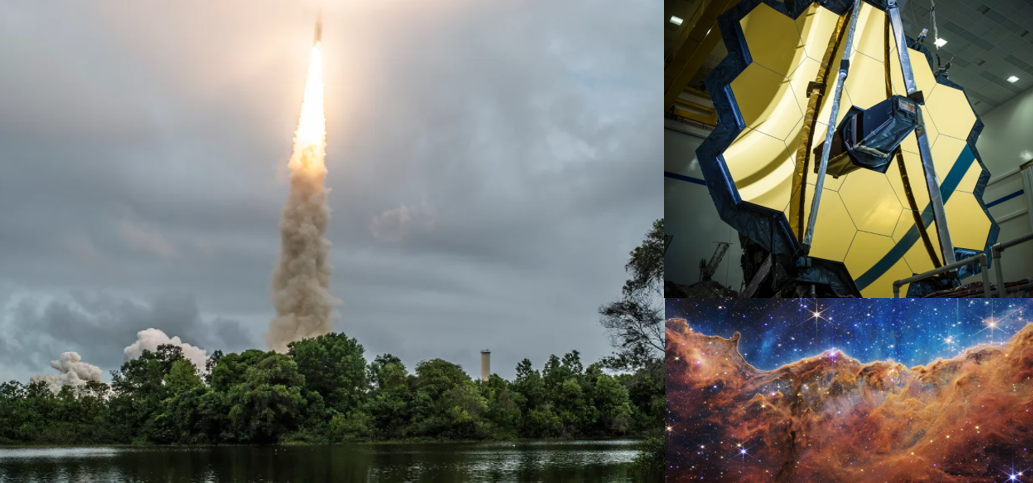
It has been over a year since NASA’s premier telescope launched.

After years of delays, the highly anticipated James Webb Space Telescope launched atop a European Ariane 5 rocket. The following article will take you through the months and days leading up to the launch, and will go over some of the discoveries and images the telescope has made just one year into operation.

Delays…Delays…Launch!
With an original launch date eyed for 2007, the James Webb Space Telescope (JWST) was no stranger to delays and cost overruns. While the initial design work for the telescope began in 1996, a major redesign in 2005 contributed to the delays, as well as cost overruns, totaling a total of US$10 billion, US$9 billion above the original budget.
Nevertheless, construction was completed in 2016 by Northrop Grumman, the lead contractor for the telescope, and following a number of tests was launched on the 25th of December in 2021 on an Ariane 5 rocket from the French Guiana.

Commissioning
Following the launch, the JWST had to travel to a point in space known as the Sun-Earth L2 Lagrange point, approximately 1.5 million km away from Earth. This journey took approximately thirty days, and provided ample time to test and unfold the complex mirrors and solar shield. The telescope reached the Lagrange point on the 24th of January 2022, performing one last course correction to insert the telescope into an orbit around the point.
The following five months consisted of the testing and aligning of the complex mirror array, as well as capturing several test images to aid in the alignment process.


First Light
The James Webb Space Telescope released it’s first set of images on the 12th of July, 2022. The first five images gained instant international fame, having been the culmination of years of development, delays, and work by countless scientists and agencies.

Deep Field
Galaxy cluster
SMACS J0723.3-7327
The first official image released by the JWST team. This deep field image is a recreation of an iconic image taken by the Hubble Space Telescope. Each speck of light represents a galaxy!
Cosmic Cliffs of the Carina Nebula
Emission Nebula
NGC 3324
Approximately 7,500 light years away from Earth, intense ultraviolet radiation and stellar winds shaped the “cliffs” seen in the image. This image only represents a fraction of the entire Carina Nebula.


Southern Ring Nebula
Planetary Nebula
NGC 3132
NGC 3132 is approximately 2,000 light years away from Earth. Despite the name, this planetary nebula formed as the result of the central white dwarf shedding its outer layers, which form the bright halo seen in the image, and not from a planet.
Stephan’s Quintet
Galaxy Cluster
NGC 7320, NGC 7319, NGC 7318a/b, NGC 7317
Stephan’s Quintet is located approximately 300 million light years away from Earth, and is a grouping of five galaxies, four of them forming the first compact galaxy cluster ever discovered.


Atmosphere Composition
Hot Gas Giant Exoplanet
WASP-96 b
Webb has also captured an atmospheric composition of an exoplanet using the Near-Infrared Imager and Slitless Spectrograph (NIRISS) instrument. This data shows the presence of high water content in the atmosphere of this gas giant.
More Images
Over the following few months, JWST released several images of a few galactic (and extragalactic) points of interest. Here are some of the highlights (not all images will be included).

Cartwheel Galaxy
Lenticular Ring Galaxy
ESO 350-40/PGC 2248
Released on the 2nd of August 2022, and located approximately 500 million light years away, the Cartwheel galaxy is famous for it’s unique shape, whose formation has been a mystery to it’s discoverer, Fritz Zwicky.
Jupiter System
Rings and Magnetosphere
Solar System
This image of our own gas giant was released on the 22nd of August, 2022, and depicts the magnetosphere of the planet at the poles, as well as the planetary ring, and the moons of Amalthea and Adrastea to the left.


The Phantom Galaxy
Large Spiral Galaxy
Messier 74
This image was released on the 29th of August, 2022. Located approximately 32 million light years from Earth, this image depicts the nucleus of the galaxy in astounding detail.
The Tarantula Nebula
Emission Nebula
30 Doradus
Released on the 6th of September, 2022, this image depicts the core of the Tarantula Nebula, taken by the NIRCam instrument. This nebula is located within the Large Magellanic Cloud galaxy some 160, 000 light years away from Earth.


Neptune System
Rings and Moons
Solar System
The NIRCam instrument captured one of the clearest views of Neptune in the past few decades on the 21st of September, 2022. This image depicts the planetary rings around the planet, as well as several Neptunian moons, most notably being Triton, the large object in the top left.
Cosmic Fingerprint
Binary System
Wolf Rayet 140
This image, released on the 12th of October, 2022, depicts a binary star system and a series of cosmic dust rings in a concentric pattern around the stars, located approximately 5,500 light years away from Earth. As the name suggests, these rings resemble a fingerprint.


Pillars of Creation
Eagle Nebula
NGC 6611/Messier 16
One of the most famous images by Webb (and by the Hubble Space Telescope), this image was taken in near-infrared and released on the 19th of October, 2022. Compared to the famous image taken by Hubble, the increased capability of the telescope becomes clear. It must be noted that the Pillars of Creation are only a small portion of the Eagle Nebula, which is located approximately 5,700 light years from Earth.
Dust Around a Protostar
Dark Cloud Nebula
L 1527
Released on the 16th of November, 2022, this image depicts the hourglass shape of the dust forming around a Protostar located in a the dark cloud nebula L 1527, approximately 460 light years away.

What is Webb Up To Now?
The James Webb Space Telescope is still hard at work studying the Universe and producing awesome desktop wallpapers. More of these images can be found on the official James Webb Space Telescope website.

Sources and Credits
All of the images in this article are available on either the official JWST website or the NASA Sciences website, and are all in the public domain. Supplementary information was also sourced from the NASA Sciences website.

Leave a Reply