
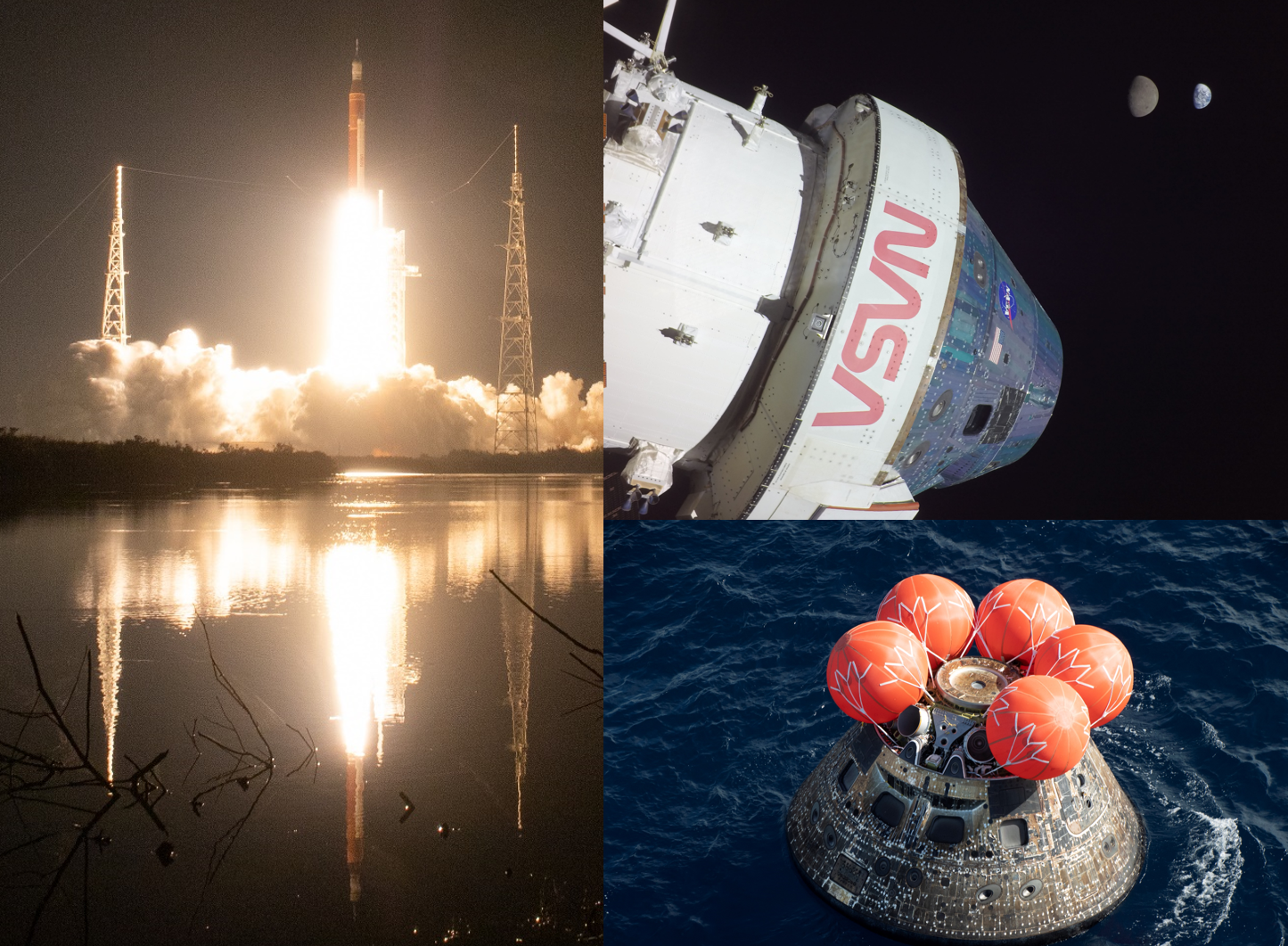
A brief recap of NASA’s intrepid capsule and her adventures.

THE MOON – On the 16th of November, NASA launched the first mission of the Artemis program, which aims to return humanity to the surface of the Moon for good, and provide a gateway for future deep space missions. The leadup to the launch was not all smooth sailing however.

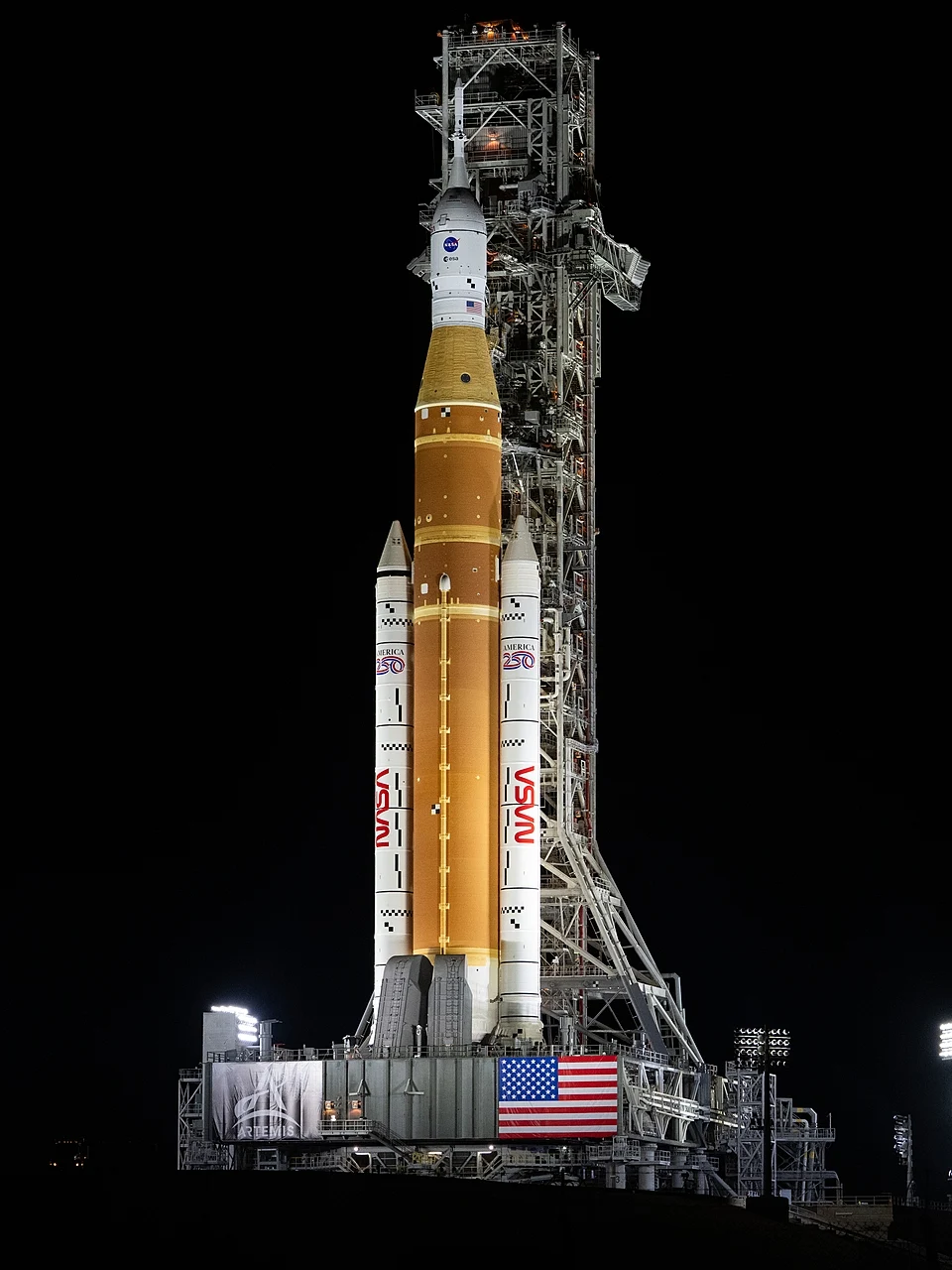
NASA’s Space Launch System, or SLS, is a heavy-lift launch vehicle which, as of 2022, boasts the highest payload capacity of any rocket in current operation. At a height of 98 meters and mass of over 2,500 tonnes, SLS is also the largest rocket in operation today. Built using technology and components from the Space Shuttle program, the SLS was designed to be NASA’s answer to the need for a heavy-lift rocket, however the rocket’s entry into service has been delayed by many years, having it’s maiden flight scheduled for 2016. Currently, there are plans for future variants of the rocket with improved capabilities, named the Block 1B and Block 2 variants.

Prelaunch – A Shaky Start

The SLS rocket first rolled out of High Bay 3 on March 17, 2022. The purpose of this rollout was to preform a wet dress rehearsal (WDR), however after a number of delays and problems, the rocket was rolled back to the Vehicle Assembly Building (VAB) for repairs on April 26.
The second rollout occurred on June 6th to reattempt the WDR. On June 20th, after the fourth WDR attempt, NASA mission managers determined they had completed most of the test objectives and declared the WDR campaign complete. The vehicle later rolled back for final launch preparation on the 2nd of July.

SLS would roll out for a third time on August 17th, which then passed it’s flight readiness review on the 23rd of August. Fueling of the vehicle commenced just after midnight on the 29th of August, however just before the planned launch at 8:33 am, a false sensor reading for engine 3 a well as other problems concerning the insulating foam of the fuel tanks led to the scrub of the launch.
Another attempt was made on the 3rd of September, however this attempt was scrubbed due to a fuel supply line leak in the mobile launcher. Following the repair of the fuel line, Hurricane Ian threatened the safety of the pad and vehicle, and a decision to rollback for a third time was made on the 26th of September.SLS would roll back to the pad for the final time on the 4th of November, aiming to launch on the 12th, however due to Hurricane Nicole, the launch would be rescheduled for the 16th.
The Launch of Artemis 1
The launch of Artemis 1 commenced on the 16th of November, 2022 at 6:47:44 UTC, marking the first launch of the Artemis program, as well as the first launch from Kennedy’s LC-39B since the Ares 1-X.

The launch proceeded as planned, with solid rocket booster separation, fairing jettison, and core stage separation occurring flawlessly. At 7:41 CST, the Interim Cryogenic Propulsion Stage (ICPS) completed a perigee raise maneuver, putting Orion in a stable orbit around Earth.
Orion’s Journey
The ICPS preformed a trans-lunar injection burn that lasted 18 minutes, completing at 8:35 CST, which was followed by the Orion and service module separation just over 10 minutes later. Following a trajectory correction burn, Orion’s three day coasting phase commenced.

Orion entered a distant retrograde orbit (DRO) of the Moon on the 25th of November, and remained in DRO until December 1st.


Orion’s Return to Earth
After completing a number of tests of the Orion spacecraft, and numerous photoshoots, the service module began the DRO departure burn at 21:53 UTC on the 1st of December. Due to the nature of the mission profile, the Orion would make one last close approach of the Moon on the 5th of December, before it’s return coast until the 11th.
After a 6 day long return transit, the Orion capsule separated from its service module at approximately 17:00 UTC on the 11th of December, and then began atmospheric reentry at 17:20 UTC travelling nearly 40,000 km/h using a “skip entry” profile. This method of entry involves two phases of deceleration, which would expose human occupancy to less intense G-forces than during an Apollo-style reentry.
Following reentry, Orion deployed its three main parachutes and splashed down at 17:40 UTC on the 11th of December, west of Baja California near Guadalupe Island.

Next Steps For Artemis
With the success of Artemis 1, Artemis 2 is next in line for NASA’s important mission of returning humans to the Lunar surface. Currently, the mission is set to launch in May of 2024, however with the numerous delays that the Artemis program has faced in the past, a delay would not be a surprise. Artemis 2 plans to bring four astronauts in a close flyby of the Moon, returning to Earth after ten days. Whether or not this mission proceeds on time is unsure at this point, however with the resounding success that Artemis 1 was, things are looking bright for the Artemis program.
Leave a Reply